
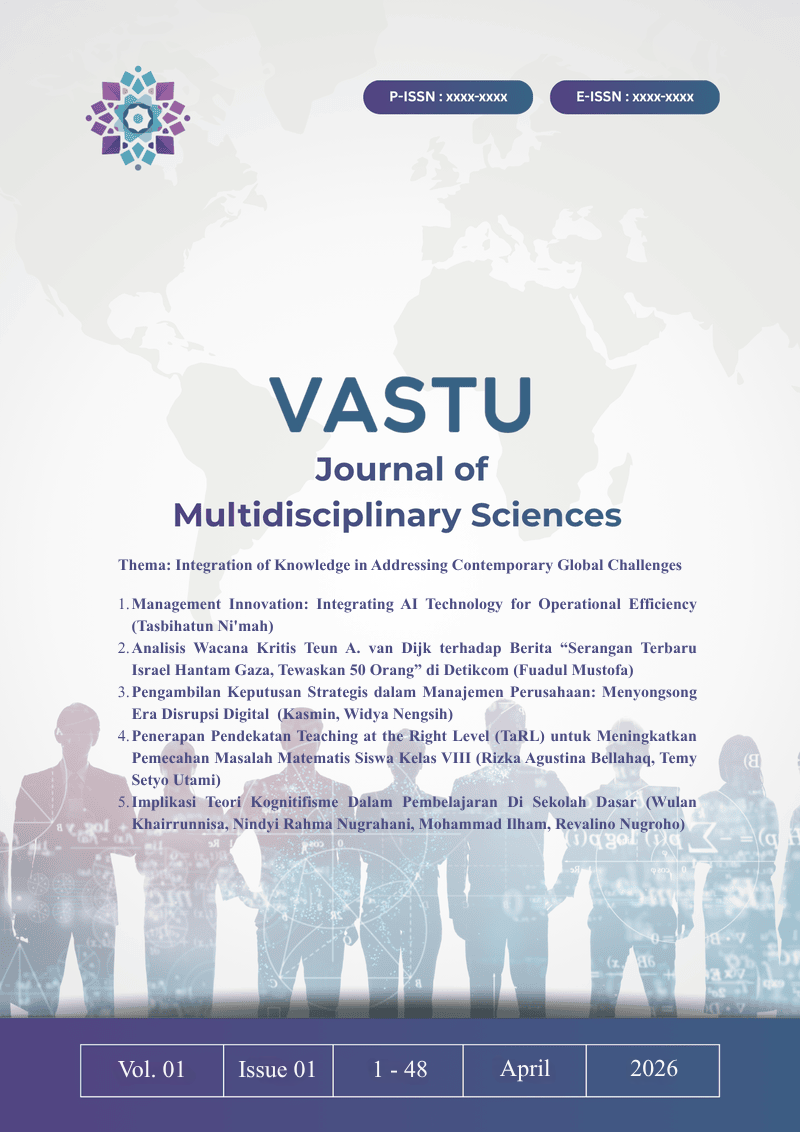
Management Innovation: Integrating AI Technology for Operational Efficiency
Bilah Samping Artikel
Isi Artikel Utama
Abstrak
This research aims to examine management innovation: integrating AI technology for operational efficiency. Advances in artificial intelligence (AI) technology have opened up new opportunities in optimizing operational processes in various sectors, from manufacturing, customer service, to education. This technology provides the ability to analyze data at scale, make accurate predictions, and automate routine tasks that previously required a lot of time and human resources. This research uses a qualitative approach with in-depth interviews with leaders and employees in several companies that have implemented management innovations: integrating AI technology for operational efficiency. The findings of the study show that with AI's ability to analyze data deeply and generate accurate predictions, organizations can increase productivity while reducing operational costs. However, the application of AI also faces challenges such as resistance to change, high initial investment requirements, and data privacy issues. Strategies to address these challenges include human resource training, collaboration with technology partners, and the development of AI ethics policies. With careful planning and an inclusive approach, AI technology is not only a tool for innovation, but also a strategic partner in organizational transformation. This article provides insights into how AI can be integrated into management models to create more adaptive and competitive organizations amid the dynamics of global change.
##plugins.themes.bootstrap3.displayStats.downloads##
Rincian Artikel
Bagian
Cara Mengutip
Referensi
Acemoglu, D., & Restrepo, P. (2020). Robots and jobs: Evidence from US labor markets. Journal of Political Economy, 128(6), 2188-2244.
Bennett, M., et al. (2019). AI for energy optimization: Challenges and opportunities. Energy Policy, 133, 110827.
Brown, T., et al. (2022). AI-driven logistics: A case study. Journal of Supply Chain Management, 58(2), 12-24.
Brynjolfsson, E., & McAfee, A. (2017). The business of artificial intelligence. Harvard Business Review, 95(4), 60-70.
Choi, T. M., et al. (2021). Blockchain and AI in supply chains: A systematic review. Transportation Research Part E: Logistics and Transportation Review, 145, 102103.
Davenport, T. H., & Ronanki, R. (2018). Artificial intelligence for the real world. Harvard Business Review, 96(1), 108-116.
Grewal, D., et al. (2020). Intelligent agents in consumer markets: Understanding their role and impact. Journal of Consumer Research, 47(1), 9-26.
Jagtap, S., et al. (2020). Applications of artificial intelligence in sustainable manufacturing: A review. Journal of Manufacturing Systems, 56, 38-52.
Johnson, L., et al. (2021). Enhancing customer experience through AI. Journal of Financial Services Marketing, 26(1), 45-58.
Kotter, J. P. (2012). Leading change. Harvard Business Review Press.
McKinsey Global Institute. (2020). The future of work in technology.
Smith, A., et al. (2023). AI in healthcare: Revolutionizing patient care. Health Informatics Journal, 29(3), 189-205.
Varian, H. R. (2019). Artificial intelligence, economics, and industrial organization. The Economics of Artificial Intelligence, 399-419.